
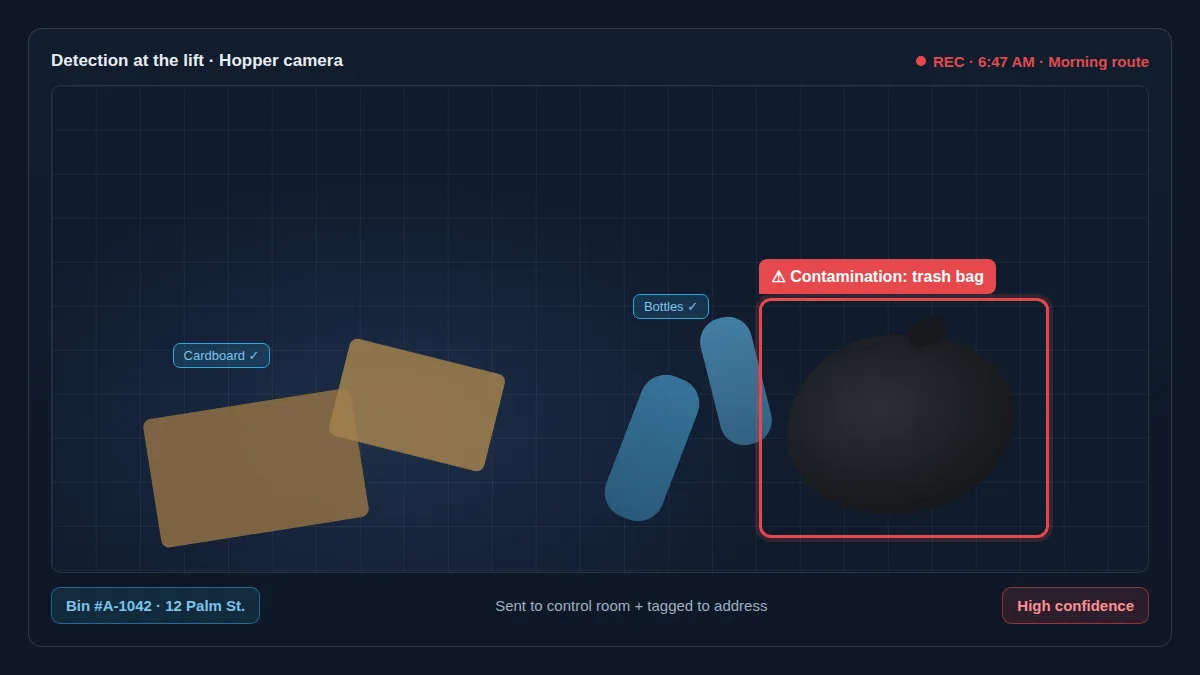
Recycling contamination and overloaded containers share one trait: both cost serious money, and both are nearly invisible to the old methods. A recycling load tainted by a single trash bag gets rejected or downgraded at the sorting station - and the program pays. A commercial container that chronically overflows grinds down equipment, endangers crews and inflates landfill bills. Manual audits catch too little, too late - and enforcement stalls without defensible evidence.
The fix: detection at the point of collection
Instead of guessing backwards at the sorting station, MIS26's on-truck AI cameras see what actually enters the hopper at the moment of the lift: a trash bag in the recycling bin, construction debris in the cardboard stream, a container over its defined threshold. Detection happens mid-route - without slowing collection, without any driver input, and without a sensor to install and maintain on every bin. The truck that already drives there is the sensor.
From detection to behaviour change
Detection alone is worth little unless it drives action. Every event is tied to a bin, an address and a time - and a picture forms: which addresses contaminate repeatedly, which streets are improving, where an education campaign works and where enforcement is due. The program moves from educating everyone to educating exactly who needs it - and repeat offenders meet enforcement backed by photo evidence that is hard to argue with.
Overloads: the money hiding in the contract
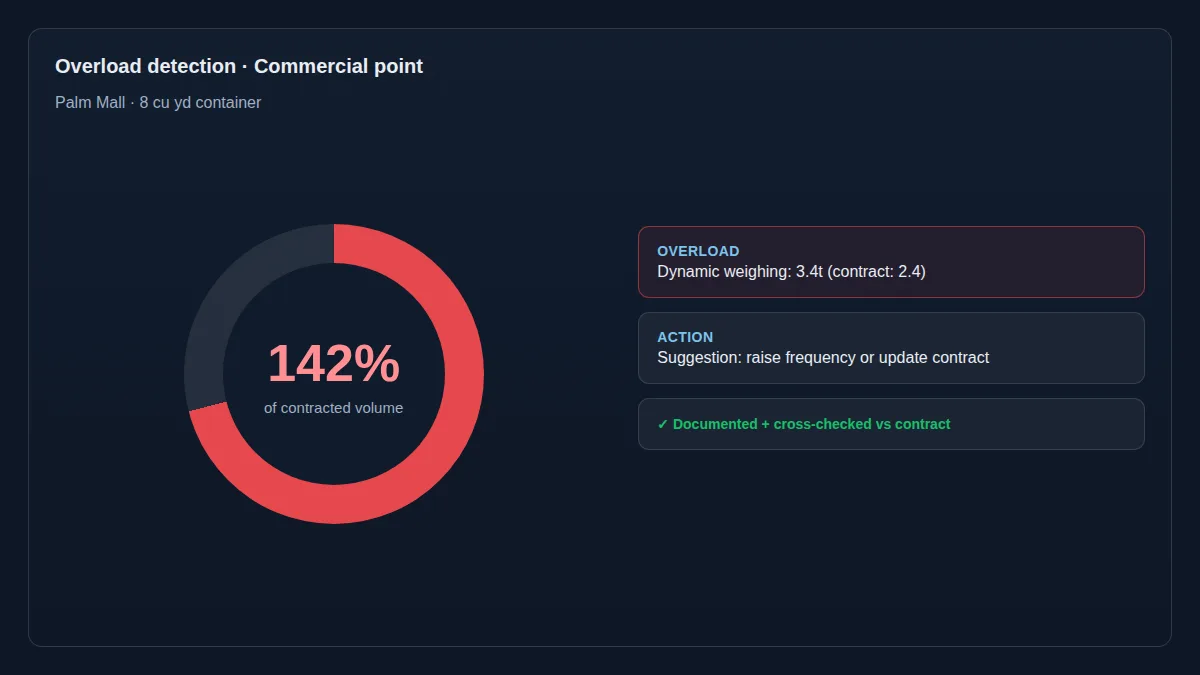
On the commercial side, the system cross-checks what the cameras see with the truck's dynamic weighing data and with the contract: a point that chronically produces 140% of its agreed volume is not a glitch - it is a receivable. Automatic detection against defined thresholds turns it from an argument into an invoice: either the contract gets updated or the collection frequency does - based on data, not gut feel.
And from here, PAYT is a short step
In the US and parts of Europe the market already runs on pay-as-you-throw - billing by what is actually thrown. This measurement chain - lift recognition, dynamic on-truck weighing, station weighbridge tickets - is exactly the required infrastructure: a measured, documented figure per bin and per customer, billing-ready. A municipality or hauler deploying the system today gets that readiness built in.
Bottom line
Fewer rejected loads, enforcement with evidence instead of arguments, contracts that reflect reality - and infrastructure ready for a weight-based billing future. Best of all: you see results in weeks, not years, because the data starts flowing from the first route. Want to see it on a real collection route? Talk to us.
Contact Us
Contact usRelated articles
AI agents for fleets: what they actually do, and why it is worth money
Everyone says AI. What an AI agent actually is on a truck fleet - what goes in, what comes out, and where the money is: control, settlement, minutes-long investigations and driver protection.
Your fleet-management data inside MIS26: whole fleet, all the data, one system
Video, AI insights - and now your existing fleet-management system's complete telematics with smart data cuts. No system-hopping, on every truck type. A true one-stop shop.
Cameras on waste trucks: the complete guide for municipalities and contractors
What gets filmed, what the AI detects, why it pays for the contractor too - and what to ask a vendor before installing. A working guide, not a marketing page.