
The traditional security stack separates two systems: a VMS that records and plays video, and an analytics system that analyzes and alerts. In practice, that separation creates the moment every operator knows: an alert pops in one system, and the manual hunt begins for the same camera, at the same minute, in the other system. In a real event, those minutes are expensive.
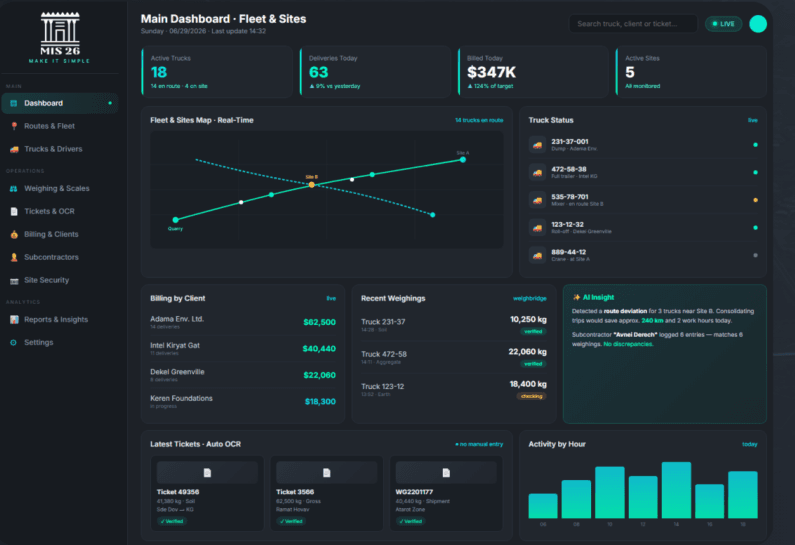
The MIS26 platform is built the other way around - unified from the ground up. Live video, recordings, AI insights and alerts live on the same screen: an analytics alert arrives with its footage already attached, and retro-investigation runs in the same interface used for live viewing. Effectively a complete VMS in which analytics is not an add-on but part of the core.
Unification has an important mobile consequence: one iPhone/Android app for live video, analytics alerts, reports and operational data. A security officer who gets an alert on the way home opens the event with its video - instead of calling the control room to ask someone to check.
And the principle crosses verticals: the same platform serves a municipal security control room, a sanitation control center and a standalone analytics post in open terrain. One system to learn, one screen to operate, one vendor accountable end to end - instead of two maintenance contracts, two versions and two points of failure.
Contact Us
Contact usRelated articles
VMS: a buyer's guide to choosing a video management system
A video management system (VMS) is the heart of any control room. What separates a system that merely records from one that understands what the cameras see - and which questions to ask before you sign.
Perimeter security without infrastructure: protecting a remote site within days
A construction site, farmland or a temporary facility - where there is no power, fiber or mast, security gets stuck at the infrastructure phase. There is a way to skip it.