
Smart Chemicals & Hazmat Carrier
Control and documentation for hazmat transport: product-mix prevention, verified discharge at the right destination, safety at discharge points and admissible documentation of every event - because with hazardous goods there is no room for error.
- Mix and wrong-connection prevention - an alert before discharge
- Safety at the discharge point: proximity alerts and exception documentation
- POD and admissible documentation per delivery - for settlement and any inquiry
- Product mixing or connection to the wrong tank/line - a safety risk and costly damage
- Discharge at the wrong destination or customer tank, with no verification beyond GPS
- Safety events and leaks at remote discharge points - with no professional eye and no documentation
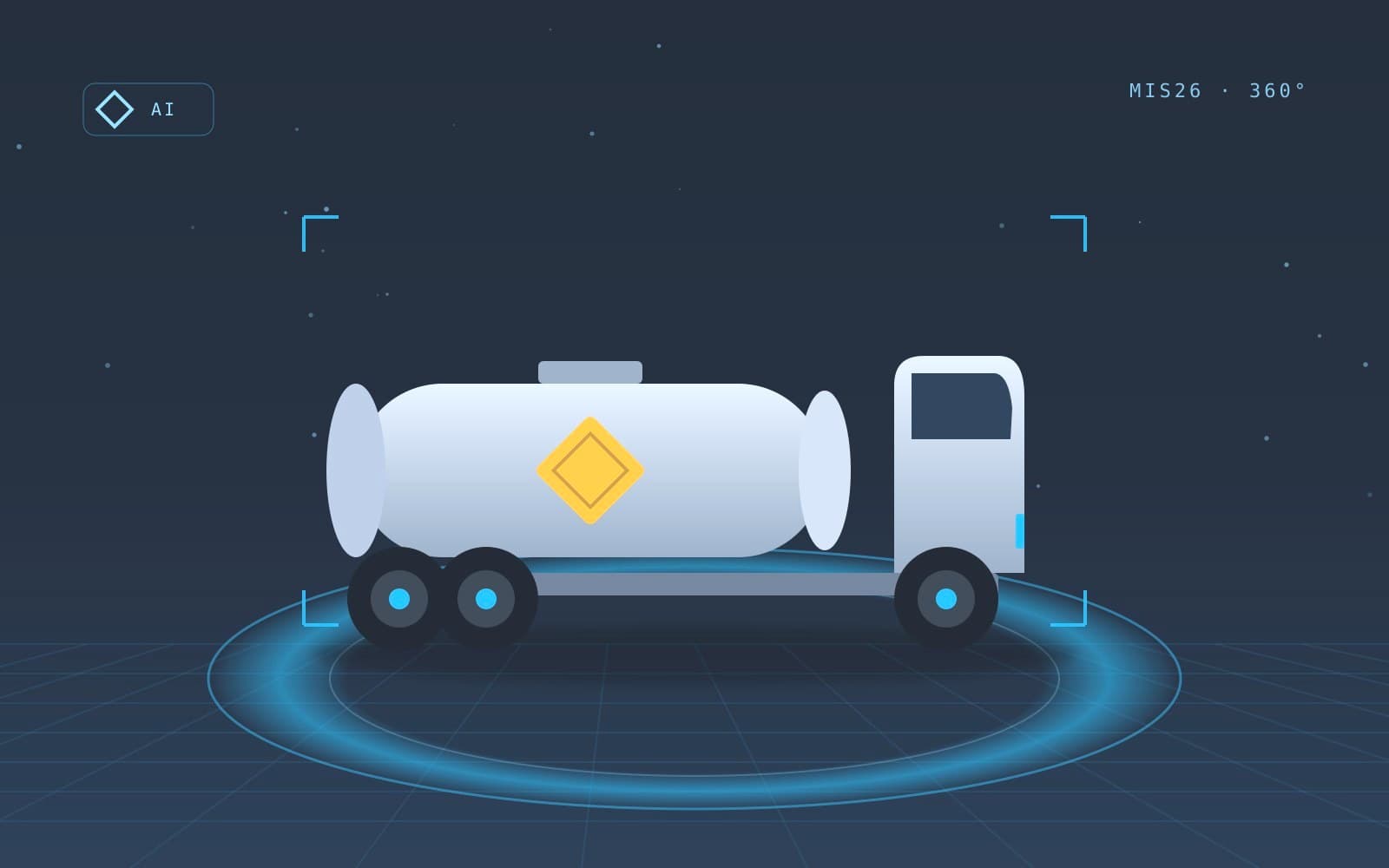
Cameras and an AI computer around the discharge points and valves: container/product assignment recognition and wrong-connection prevention, destination verification, real-time safety-event detection (a person in a danger zone, a leak) and full POD for every delivery.
- Mix and wrong-connection prevention - an alert before discharge
- Safety at the discharge point: proximity alerts and exception documentation
- POD and admissible documentation per delivery - for settlement and any inquiry
Key Capabilities
Product-mix prevention (anti-mix)
Container/product assignment recognition and verification that the right material discharges into the right line/tank - blocking a wrong connection
Discharge-destination verification
Geofencing and OCR of the customer site/tank against the order
Safety at the discharge point
Detection of a person in a danger zone, valve opening and a leak event - a real-time alert
Proof of delivery & admissible documentation
Video, time and location per delivery - documentation pulled in minutes for any inquiry
Fleet dashcam, telematics, or an adaptive AI platform
The market offers three approaches for a heavy fleet: a dashcam that records, telematics that shows location, and a video-AI platform that understands what happens on each truck type. The difference is between recording, knowing where, and understanding and proving.
| Dashcam / fleet camera | Telematics platform | MIS26 (adaptive AI video) | |
|---|---|---|---|
| LIVE video + real-time GPS | Partial | Partial | ✓ |
| Onboard (edge) AI processing, not cloud-only | ✓ | ||
| Truck-type-specific recognition (anti-mix, pour counting, silo OCR, chain of custody) | ✓ | ||
| Automatic proof of delivery / performance | Partial | ✓ | |
| Cargo & destination verification (anti-mix, geofence, OCR) | ✓ | ||
| Safety: pedestrians, dangerous proximity and driver fatigue | Partial | ✓ | |
| Customization per client and per haul scenario | Fixed | Vendor-dependent | ✓ |
| One vendor: hardware, AI, installation, support and ERP integration | Vendor-dependent | ✓ |
The comparison refers to common solution categories in the market, not to any specific vendor.
Inside the system
System Features
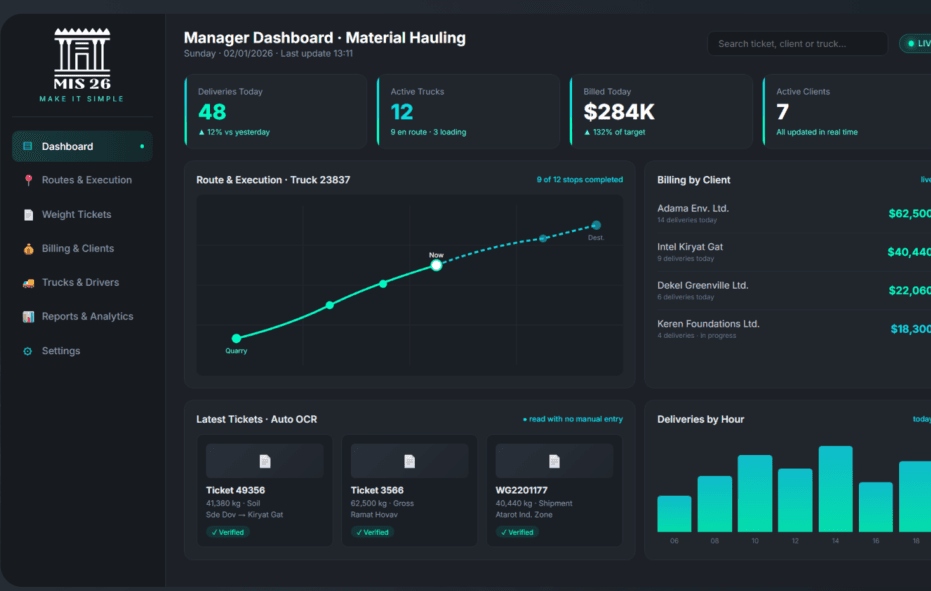
- Camera coverage around valves and discharge points
- Real-time safety alerts + Near-Miss documentation
- POD with video, time and location
- Admissible documentation that supports safety and control procedures
Key Applications
Safety & evidence: the vehicle documents, the crew is protected
Every trip is stored with video, time and location. In an inquiry, a complaint or a not-at-fault claim - the documentation already exists, is ready in minutes and is admissible as evidence.
Frequently Asked Questions
How is a wrong line/tank connection prevented?
Container/product assignment recognition and verification against the order - if the connection is wrong, an alert fires before discharge.
What is documented for safety and regulation?
Time-and-location-stamped video for every delivery, including safety events. The documentation is admissible and pulled in minutes. The system supports your safety procedures and is not a substitute for required permits and standards.
How is data secured?
Enterprise-grade cyber security: storage and backup to international standards, role-based permissions and an option for fully on-prem deployment with no external connection.
What happens without internet?
The system keeps working: recording and processing run locally on the vehicle, and data syncs to the cloud once connectivity returns - no events lost.
How long is footage kept?
Playback reaches up to six months back - video, stills, locations and event data, with targeted retrieval in minutes.
Related systems
Want to see it on your fleet?
Tell us about your operation - we'll come back with a tailored solution.