
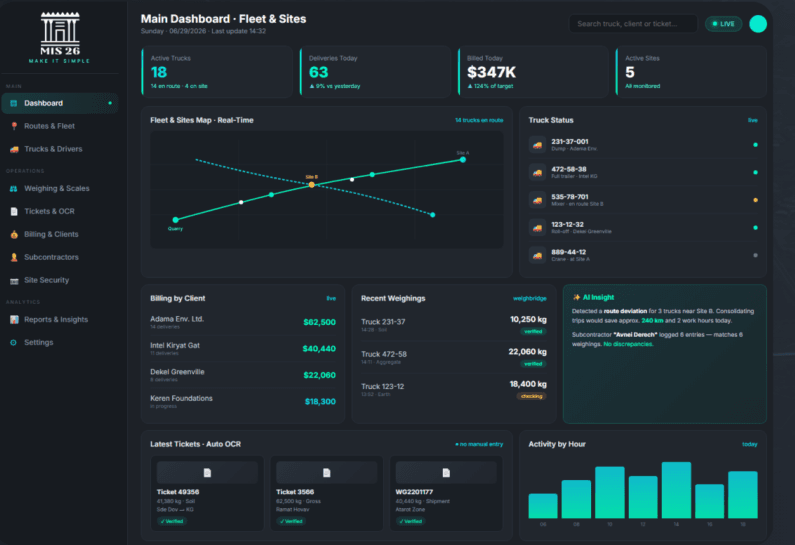
Urban sanitation management today runs mostly on reports: the contractor reports how many work days were performed, the inspector reports what he saw, and residents report what hurts. The three channels are disconnected - inspector reports scattered on WhatsApp, photos lost, and nobody links three different tickets about the same hazard. The district manager opens the morning not knowing what happened on his turf.
A sanitation control center changes the structure of the work. Instead of each channel living alone, all data - vehicle telemetry, photo-documented inspector reports, resident tickets and treatment history - flows into one city dashboard. The control-center team monitors in real time, detects deviations from the plan, opens tickets and drives resolution with the contractor through to documented closure.
The big advantage: the municipality doesn't have to build and staff this itself. In a managed-service model it chooses the involvement level: a self-serve dashboard, a managed control center that monitors on its behalf, or a full envelope with field inspectors, senior supervision and continuous optimization. At every level the municipality keeps full data access and complete transparency over its contractors.
The result is measured in three things: time - tickets close faster when the information is available; money - contractors are paid for proven execution; and trust - a resident gets an evidence-based answer instead of a promise. A city managed on data is a city that can improve, because it can finally be measured.
Contact Us
Contact usRelated articles
Contamination and overload detection - at the moment of the lift, with no bin sensors
One trash bag in the recycling bin taints a whole load. An overflowing commercial container grinds down equipment and budget. How on-truck AI cameras turn every lift into a quality check - with an address, evidence and an action plan.
AI agents for fleets: what they actually do, and why it is worth money
Everyone says AI. What an AI agent actually is on a truck fleet - what goes in, what comes out, and where the money is: control, settlement, minutes-long investigations and driver protection.
Your fleet-management data inside MIS26: whole fleet, all the data, one system
Video, AI insights - and now your existing fleet-management system's complete telematics with smart data cuts. No system-hopping, on every truck type. A true one-stop shop.